Is Skydiving In Queenstown Safe? What Operators State
Skydiving in Queenstown is weather-dependent and assessed person by person. Here is what NZONE Skydive and Skydive Wanaka actually publish about safety, and what no operator can promise.
Short answer
Both Queenstown-region operators, NZONE Skydive and Skydive Wanaka, publish detailed safety processes: tandem master assessments, weather holds, harness checks and Drop Zone Safety Officer reviews. No operator here claims a guarantee, and any skydive carries real risk that each person weighs for themselves.
| Quick fact | Detail |
|---|---|
| Operators covered | NZONE Skydive (Drift Bay drop zone, Lake Wakatipu) and Skydive Wanaka (Wanaka Airport) |
| Entry price, 9,000 ft | NZONE Skydive from USD 215.27; 3-Hour Wanaka Skydive from USD 210.16; Wanaka Skydive, Transfers Included from USD 221.25 |
| Minimum age | 6 at both operators, with assessments on the day |
| Minimum weight | NZONE Skydive 40 kg; Skydive Wanaka 30 kg |
| Weather policy | Both operators rebook first, refund in full only if no other date works |
| Review base | NZONE Skydive 4.7 from 1,479 reviews; 3-Hour Wanaka Skydive 4.8 from 295 reviews |
Is Skydiving In Queenstown Safe For First-Time Jumpers?
Every tandem skydive covered here pairs a first-timer with a tandem master who controls the jump from exit to landing, and both operators describe assessment before anyone leaves the ground: minimum ages and weights, harness fit checks, medical disclosures and weather holds. What no operator states is an accident statistic or a risk percentage. Risk in any skydive is real, and each reader decides whether to accept it.
The honest answer has two halves. The first half is structural: a tandem jump is not a solo jump. The passenger is strapped to a professional whose job is the equipment, the exit, the freefall body position, the canopy opening and the landing. Both operators state that every child is assessed by the tandem master on the day, and that anyone over 95 kg is assessed at the drop zone; NZONE's terms add a Drop Zone Safety Officer assessment for passengers over 110 kg. Those checks are published, specific and attributed on this page, not paraphrased into a comfort blanket.
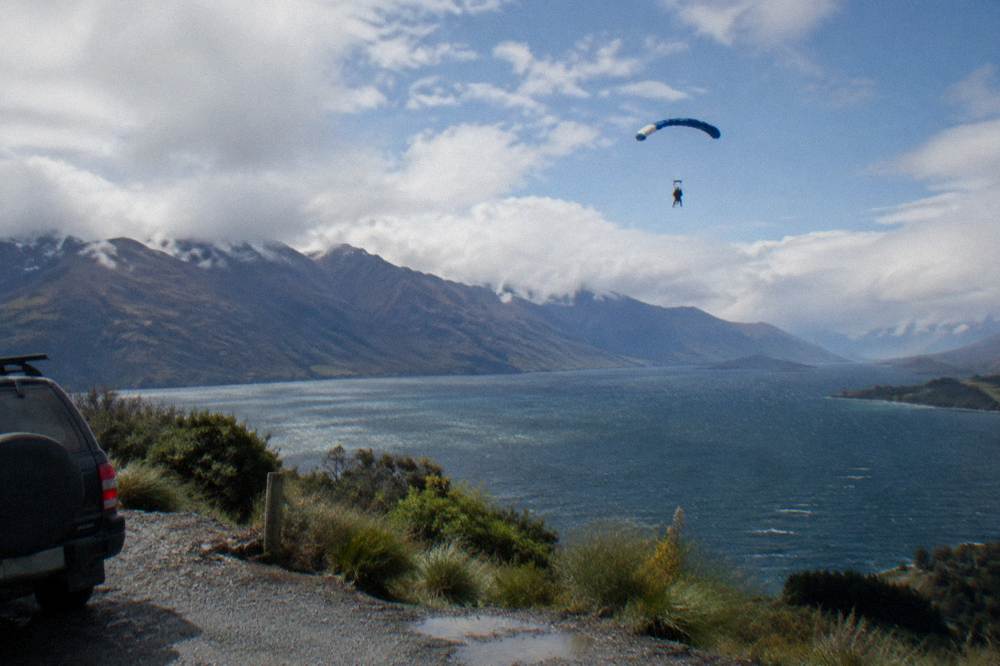
The second half is what safety looks like in practice at a mountain lake town. It looks like holds. Queenstown weather moves fast across Lake Wakatipu and the Remarkables, and Skydive Wanaka states plainly that it does not jump in strong wind or complete cloud cover, while NZONE describes its jumps as weather-dependent. A jump delayed by two hours is the safety system working, not failing. If a hold stretches into a cancellation, both operators rebook first and refund in full only when no other date works, which is a policy that prioritises jumping in good conditions over jumping on schedule.
What Do The Operators Themselves Say About Safety?
Skydive Wanaka says it has operated for more than 30 years with an exemplary safety record, describes itself as an NZPIA associate member, and says NZPIA rules cap tandem altitude at 16,500 feet above sea level. NZONE Skydive says it was New Zealand's first skydive operation and the birthplace of tandem skydiving in New Zealand, operates two Cessna Grand Caravan aircraft, and bans personal cameras on jumps. These are the operators' own statements, reported as such. If you were hoping to film the jump yourself, the guide to holding your phone while skydiving explains why Queenstown operators say no and what photo and video packages they sell instead.
Reading the operators' own pages is the most reliable thing a nervous first-timer can do, because the claims there are specific and checkable. Skydive Wanaka's frequently asked questions page explains why its highest jump is 15,000 ft above ground, which at Wanaka is 16,100 ft above sea level, and states that NZPIA rules cap tandems at 16,500 ft above sea level. That is a published ceiling, not a marketing line, and it is the reason no Queenstown-region operator sells anything above 15,000 ft.
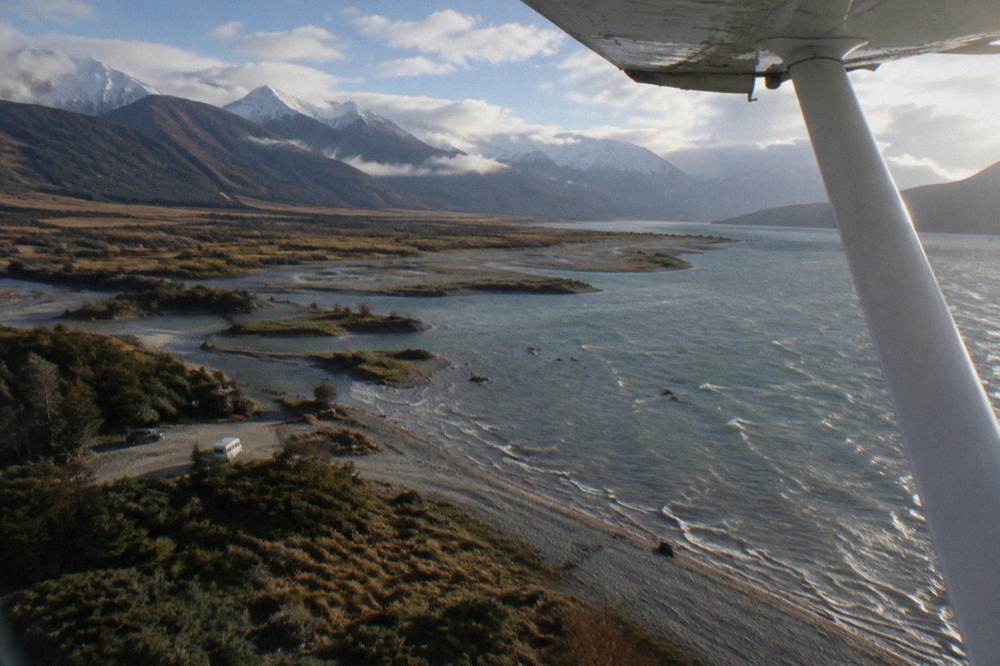
NZONE's own FAQ page carries the operational detail: flights to 15,000 ft take about 15 minutes, the plane holds up to 9 customers, children 12 and under are limited to 9,000 ft, and passengers over 95 kg are assessed by the tandem master at the drop zone. It also repeats a New Zealand industry safety requirement that personal cameras and smart glasses are not allowed on the jump, because a loose object in freefall is a genuine hazard rather than a bureaucratic rule.
Operators' self-descriptions are exactly that, self-descriptions, and a reader should treat them as a starting point for questions rather than a verdict. The practical takeaway is different: the operators publish detailed, restrictive rules, and restrictive rules are the visible surface of a safety culture, even when the statistics behind it stay private.
For readers ready to look at the actual jumps behind those rules, these are the three tandem options covered on this site:
Each is a tandem jump with a tandem master on every flight, at one of two drop zones, and each is weather-dependent. The sections below explain where their safety processes differ.
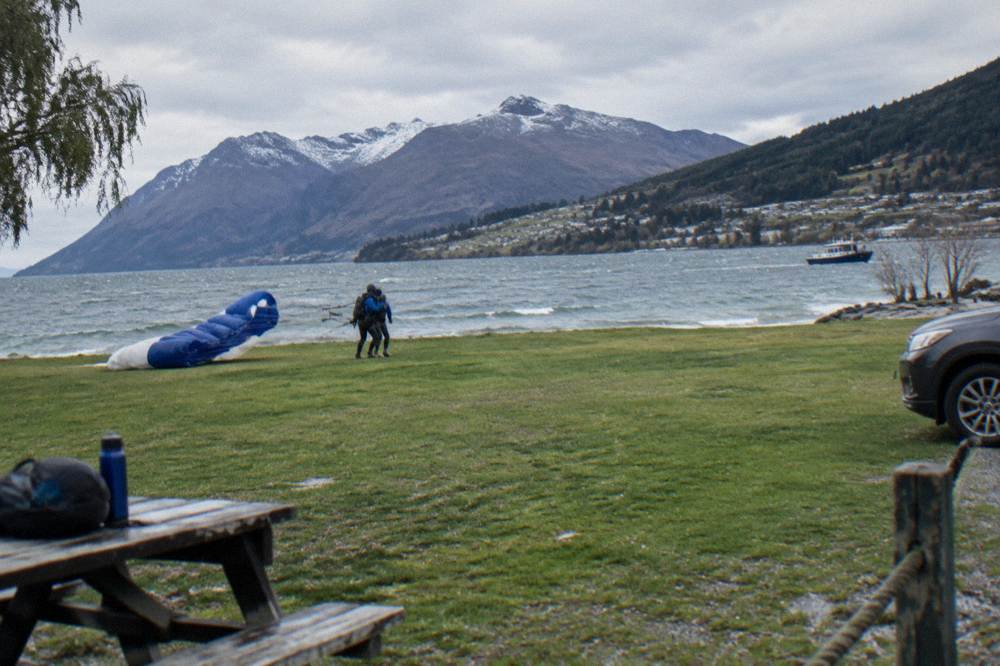
Who Gets Assessed, And For What, Before A Queenstown Skydive?
NZONE Skydive requires a minimum weight of 40 kg and Skydive Wanaka requires 30 kg, both require a minimum height of 1.2 m and a harness that fits, and both state that anyone over 95 kg is assessed by the tandem master at the drop zone. Skydive Wanaka charges weight surcharges of NZD 50, NZD 75 or NZD 100 payable at check-in from 95 kg up. Neither operator quotes a firm maximum.
The assessment system is where operator statements get genuinely granular, and where the two operators differ enough that a reader should check the right one. NZONE Skydive's terms say over 110 kg triggers an extra assessment by a Drop Zone Safety Officer or tandem master and is subject to the availability of qualified tandem masters; Skydive Wanaka's terms match that wording and add that anyone over 95 kg should tell reservations before the jump date. Both operators say limits vary by drop zone and by day, which is why neither prints a single hard maximum.
| Assessment point | NZONE Skydive (Drift Bay) | Skydive Wanaka (Wanaka Airport) |
|---|---|---|
| Minimum weight | 40 kg | 30 kg |
| Minimum height | 1.2 m | 1.2 m |
| Over 95 kg | Tandem master assessment at drop zone | Tandem master assessment; tell reservations before jump date; stated surcharges NZD 50 to NZD 100 at check-in |
| Over 110 kg | Extra Drop Zone Safety Officer or tandem master assessment; subject to tandem master availability | Extra assessment; most drop zone maximums 110 to 115 kg |
| Children 12 and under | Maximum altitude 9,000 ft; assessed on the day | Maximum altitude 9,000 ft; assessed on the day |
| Under 18 | Written parental or guardian consent | Written parental or guardian consent |
Age works differently from how many first-timers expect. Six is the minimum at both operators, there is no maximum age, and NZONE records passengers up to 94 years old while Skydive Wanaka records 92. Medical disclosure sits beside the age rules: both operators ask to be told before booking about recent injuries or surgery, mobility limits, epilepsy, high blood pressure, angina and heart conditions, and both reserve the right to ask for a doctor's medical clearance. A head cold or blocked sinuses on the day can also be a problem at altitude, so honesty at check-in is part of the system. Those age and health rules apply to whoever ends up jumping, so if you're considering a tandem skydive as a present, the guide to giving a Queenstown skydive as a gift covers prices, booking validity and which tour suits which recipient.
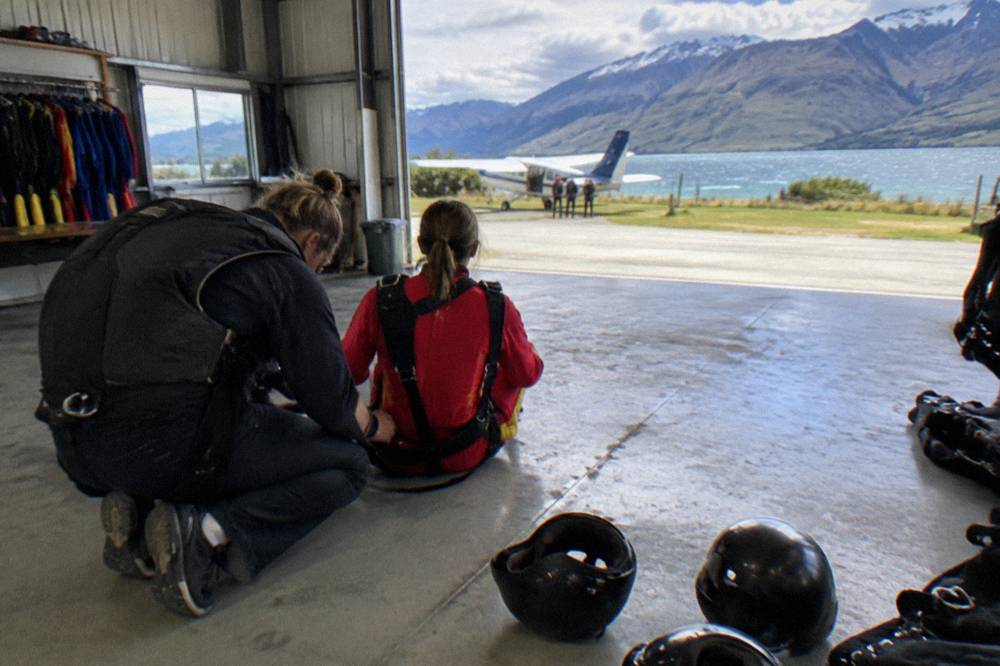
The most-reviewed option here, NZONE Skydive at 4.7 from 1,479 reviews, runs about 3.5 hours from check-in at 35 Shotover Street to return, with a courtesy coach to the Drift Bay drop zone included in the price. Reading the operator's own terms before booking is the single most useful safety step a reader can take, and NZONE's terms and conditions page spells out the assessment, consent, alcohol and medical rules in full.
The 3-Hour Wanaka Skydive applies Skydive Wanaka's own assessment rules at Wanaka Airport, including the lower 30 kg minimum weight, and carries 4.8 from 295 reviews. Pickup for it is the Wanaka i-SITE shuttle point at 103 Ardmore Street, selected at booking; it has no Queenstown transfer.
What Weather Rules Stop A Queenstown Skydive?
Both operators treat skydiving as weather-dependent, with Skydive Wanaka naming strong wind and complete cloud cover as stopping conditions, and both rebook passengers rather than jumping in marginal conditions. If no other date works, a full refund applies. Weather is the reason operators advise booking your first available day and keeping a spare day free, and it is the most likely reason a booked jump moves.
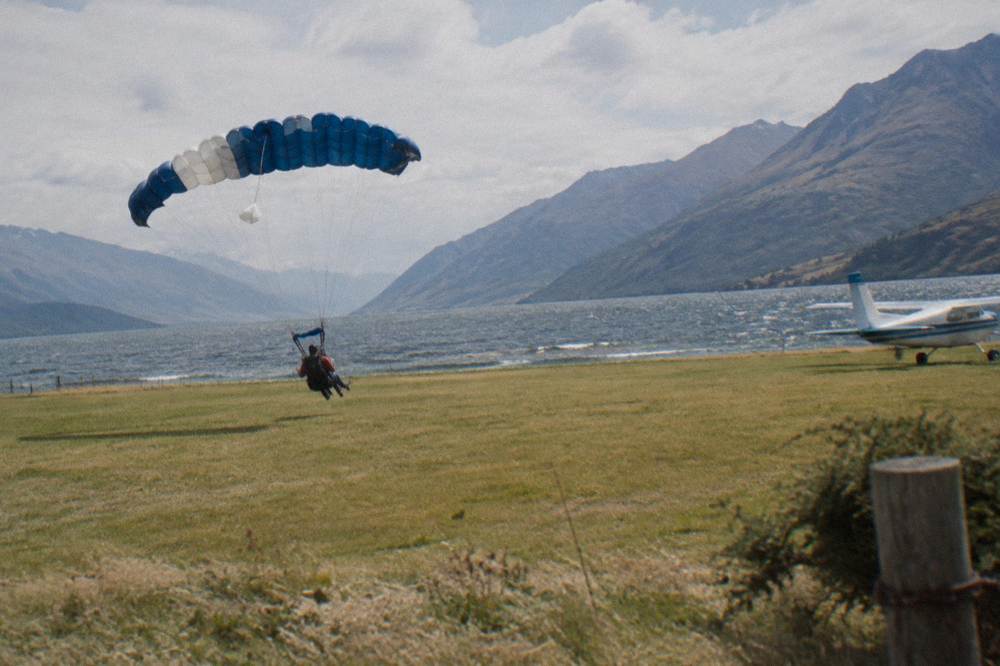
Weather holds are the part of skydive safety the passenger actually experiences. A booking carries a check-in time, not a jump time, and Skydive Wanaka asks passengers to call 30 minutes before their booking to check conditions. NZONE operates seven days a week through the day, which gives rebooking slots room to breathe, and its FAQ states that if a trip cannot be rearranged, the passenger is refunded in full from wherever they paid originally. Neither operator frames this as an apology; it is the standard operating pattern for aviation that depends on the sky.
The deeper guide to conditions, seasons and timing sits on the Queenstown skydive weather page, but the safety-relevant core is simple. Holds happen. A hold protects the passenger, the tandem master and the aircraft, and a reader who cannot accept a possible delay or a possible date change should think carefully before booking any skydive. The best time of year to skydive in Queenstown matters here too, since clearer, calmer patterns reduce, without ever removing, the chance of a hold.
| Weather scenario | NZONE Skydive stated response | Skydive Wanaka stated response |
|---|---|---|
| Unsuitable conditions before check-in | Rebook to the next suitable slot | Rebook later same day or next day |
| No workable alternative date | Full refund from wherever you paid | Full refund when rebooking is not possible |
| Higher-value change chosen by customer | Customer pays the difference | Customer pays the difference |
| Customer cancels | Free up to 24 hours before departure | Free up to 24 hours before departure |
| Booking validity | 12 months from original departure | 12 months from original departure |
One detail worth knowing: NZONE's terms allow it to change aircraft, drop zone, altitude, freefall duration and times without a refund claim when conditions demand it. That clause reads harshly but is the aviation version of the same principle, the operation bends around the weather rather than the other way round. A reader who books understanding this will not feel ambushed by a two-hour wait or a shifted altitude.
What Equipment And Aircraft Do The Operators Use?
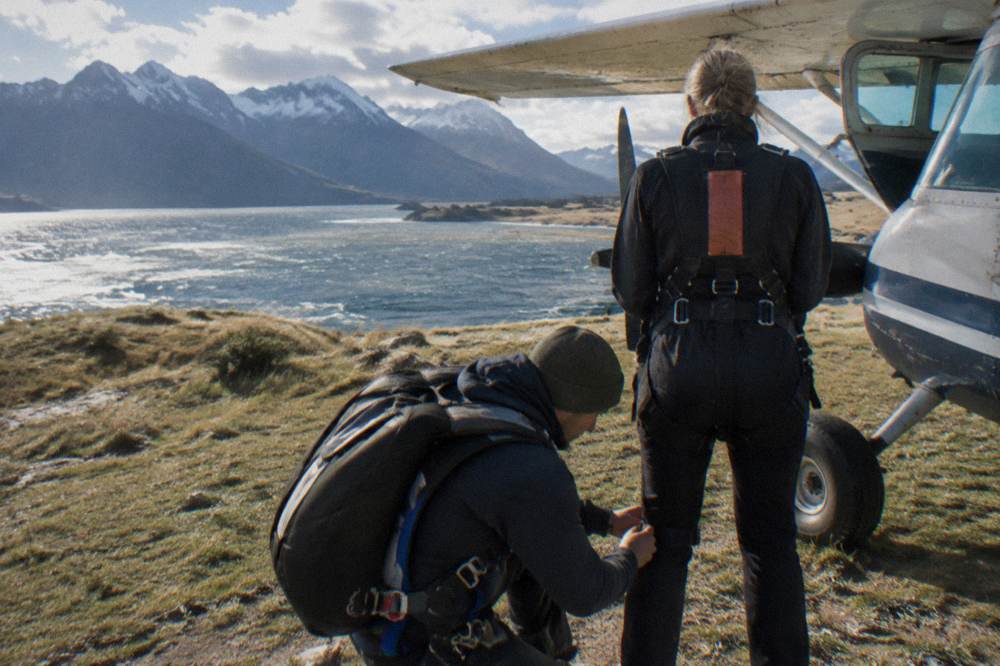
NZONE Skydive states it operates two Cessna Grand Caravan aircraft, each holding up to 9 customers, and both operators supply a full jumpsuit, gloves, hat and goggles, with goggles that fit over glasses. Both ban personal cameras and smart glasses on the jump under an NZPIA safety requirement. Neither operator publishes equipment inspection schedules, so those specifics are not stated here; asking the operator directly is the right move.
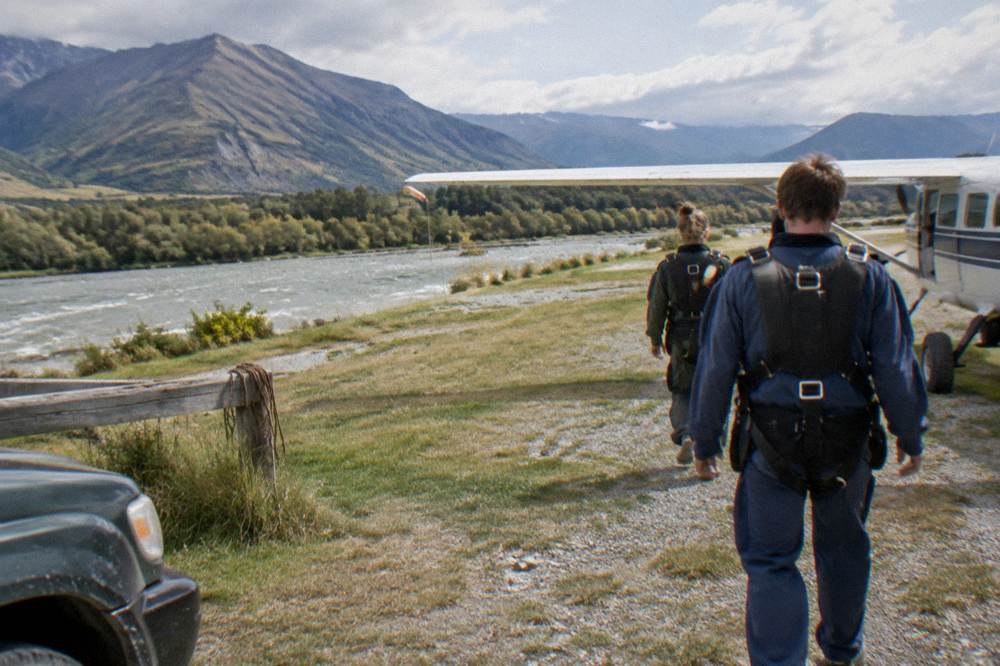
The kit a passenger wears is the part of the system they can see and touch. Both operators provide the jumpsuit, the headgear and the eyewear, and both say secure enclosed tie-up shoes are required, with warm layers in winter. The harness is fitted by the team, and the fit check is one of the stated reasons a passenger can be reassessed on the day even after passing the weight and height minimums. Photos and video, where wanted, are captured by the operator's own camera systems, either a wrist-mounted camera handled by the tandem master or a dedicated freefall camera flyer, never by the passenger's own phone.
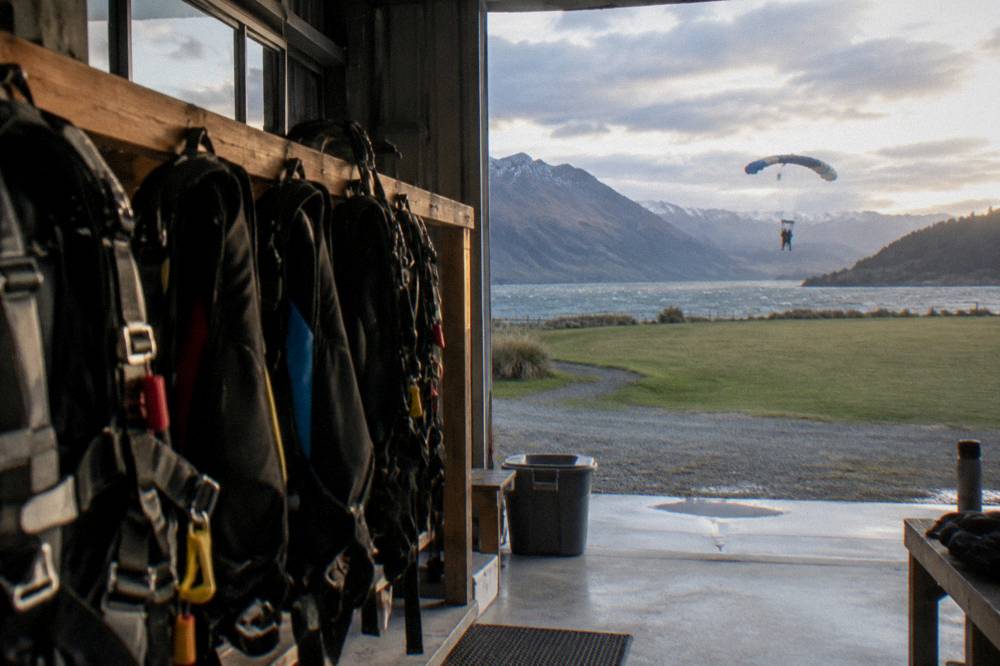
Aircraft statements are similarly concrete. NZONE describes its two Cessna Grand Caravans ("Supervan 900"), each holding up to 9 customers, and its prices page notes a 15 to 20 minute flight to altitude, which matters for a reader weighing how long they will sit with their nerves at 15,000 ft. Skydive Wanaka jumps from Wanaka Airport over Lake Wanaka and Mount Aspiring scenery, with landing at a private working farm nearby.
The altitude ceiling is itself a safety statement worth reading closely. Skydive Wanaka says it does not jump from above 15,000 ft above ground level because NZPIA rules cap tandem jumps at 16,500 ft above sea level, and at Wanaka 15,000 ft above ground already sits at 16,100 ft above sea level. That is the reason a reader searching for a "higher" Queenstown jump will not find a legitimate one on any operator prices page: 15,000 ft is the published maximum for both operators, and anything advertising more should be treated with suspicion.
The freefall figures the operators publish are "up to" numbers: up to 25 seconds at 9,000 ft, up to 45 at 12,000 ft and up to 60 at 15,000 ft, and NZONE puts the speed at around 200 km/h. The skydive freefall time by altitude guide unpacks those numbers; the safety point is simply that the operators quote ranges, not guarantees, because exit altitude, aircraft run-in and conditions all vary.
What Can You Check Yourself Before Booking?
A reader can verify a great deal without trusting any review: read the operator's own terms, ask direct questions by phone or email about assessments and conditions, disclose medical facts before booking, check the weather policy, and confirm the meeting point and transport. Both operators publish contact details, NZONE on +64 3 442 5867 and Skydive Wanaka on 0800 786 877. Free cancellation up to 24 hours before departure is stated by all three tours here.
The questions worth asking are the ones this page has already surfaced. What happens if I am over 95 kg? Is there any condition under which my child cannot jump? What is your policy if I feel unwell on the day? Where exactly do we land, and can my family watch? Each has a published answer for each operator, and hearing the answer from the operator itself, in its own words, does two things: it gives you the accurate version, and it shows you how the operation communicates, which is itself information. Skydive Wanaka's getting here page, for example, states plainly that there is no safe spectator viewing at its farm landing zone and that family should wait at the airport base, which is exactly the kind of unsentimental detail a good operation publishes.
| What you can verify | Where to check | What a good answer looks like |
|---|---|---|
| Weight and age assessment rules | Operator terms and FAQ pages | Specific thresholds and named assessors, not vague reassurance |
| Weather hold and refund policy | Operator terms | Rebook first, full refund if no date works |
| Medical and alcohol rules | Operator terms | Listed conditions and an 8 hour alcohol rule before jump time |
| Meeting point and transport | Operator booking information | A named address, with what transport is and is not included |
| Photo and video capture | Operator photo pages | Operator-held cameras only, personal cameras banned |
Then there is the booking mechanics. A booking carries a check-in time, not a jump time; government-issued photo ID is required at the drop zone; alcohol and recreational drugs are banned within 8 hours of the jump; and scuba diving within 24 hours is ruled out by both operators' terms. Knowing these before the day removes every avoidable reason a jump might be refused at check-in, and the remaining reasons, weather among them, are the ones nobody can remove.
If Queenstown is your base and you want the scenery of the Wanaka side, the option that matters is Wanaka Skydive, Transfers Included, which adds a return transfer from 35 Shotover Street, about 1.5 hours each way, running Monday, Wednesday, Friday and Sunday. Its rating rests on only 3 reviews, so treat the score as thin evidence rather than a verdict; the safety rules that apply are Skydive Wanaka's own, published and checkable, and it runs up to 6 hours door to door.
What Mistakes Trip Up First-Time Skydivers In Queenstown?
The avoidable mistakes are booking on a tight schedule with no spare day, arriving without photo ID or proper shoes, hiding a medical condition or a recent scuba dive, assuming hotel pickup exists, and expecting a fixed jump time rather than a check-in time. None of these make a jump unsafe, but each can end it before it starts. The unavoidable reality, weather, is managed by holds and rebooking.
The schedule mistake is the big one. Because both operators rebook rather than jump in marginal weather, a traveller who books the last day of a short trip has built failure into the plan. The stated advice from the Wanaka side is to book your first available day and keep a spare day free, and it is good advice for Queenstown too. The Queenstown skydive day plan guide shows how to structure that buffer without wasting the spare day.
The paperwork mistakes are smaller but absolute. No photo ID, no jump. No enclosed tie-up shoes, no jump until it is fixed. An undeclared heart condition, a dislocated shoulder that was never mentioned, or a scuba dive the day before can each stop a jump or, worse, create a genuine risk the tandem master could have managed if told. NZONE states that a previously dislocated shoulder does not automatically rule out a jump when the team knows about it, which is the pattern for almost every medical rule here: disclosure leads to management, silence leads to problems.
The transport mistake is worth a line of its own because it is pure assumption. NZONE Skydive includes a courtesy coach from its Shotover Street centre to Drift Bay, and states hotel pickup is not included. The 3-Hour Wanaka Skydive starts in Wanaka, with its i-SITE shuttle point as the only pickup, and has no Queenstown transfer at all; only Wanaka Skydive, Transfers Included bridges the two towns, on four days a week. A reader who assumes a Queenstown hotel pickup for the Wanaka jump will simply miss it. The Queenstown skydive pickup and transfer guide maps all three journeys.
Finally, the expectation mistake: treating "up to 60 seconds of freefall" as a promise. The operators publish ranges because physics and conditions vary, and a reader who holds operators to exact seconds will end up disappointed by a perfectly good jump.
So Is A Queenstown Skydive Safe? The Honest Verdict
What can be said, from operator statements alone, is that both operators run published, restrictive, person-by-person safety processes: tandem master assessments, harness fit checks, weather holds, altitude ceilings, equipment supplied by the operation and cameras banned from passengers' hands. What cannot honestly be said is that skydiving is safe, full stop. Any skydive carries real risk, and the decision to accept it belongs to the reader.
That verdict is deliberately unglamorous, because the truth is unglamorous. The reassurance available to a first-timer is not a number, it is the shape of the system: multiple independent checks, each of which can stop the jump, operated by businesses whose commercial interest is in not harming customers over decades of operation. Skydive Wanaka says 30-plus years; NZONE says it was New Zealand's first skydive operation and the birthplace of tandem skydiving in the country. Those are longevity statements, and longevity in this industry is earned, but they are still self-descriptions.
The reader's own role is not passive. Disclose, ask, read the terms, bring the ID and the shoes, book with a spare day, and accept that weather, not marketing, decides the schedule. Readers still weighing the fear itself may find the is skydiving in Queenstown scary guide and the what happens on a Queenstown tandem skydive day guide useful companions to this page, because knowing exactly what happens next is the most practical fear-reducer there is. For anyone turning next to timing, the guide to the best month to skydive in Queenstown explains why spare days on the ground matter more than the month on the calendar.
If the safety question is settled and the choice is which jump, these are the three options again, side by side:
Common Questions About Skydiving Safety In Queenstown
Is Skydiving In Queenstown Safe?
No operator states that skydiving is safe in absolute terms, and any skydive carries real risk. What is verifiable is that NZONE Skydive and Skydive Wanaka publish detailed assessment, weather and equipment rules, and that a tandem master controls the jump throughout. The decision to accept the risk is yours; read the operator terms first.
Who Decides If I Can Jump On The Day?
The tandem master does, at the drop zone, for both operators. Passengers over 95 kg are assessed on the day, children 12 and under are assessed on the day, and NZONE's terms add a Drop Zone Safety Officer assessment for passengers over 110 kg. Harness fit is part of that assessment.
Is There A Weight Limit For A Queenstown Tandem Skydive?
NZONE Skydive states a minimum of 40 kg and Skydive Wanaka a minimum of 30 kg, both with a 1.2 m minimum height. Above 95 kg, assessment applies, and both operators say at most drop zones the maximum limit is 110 to 115 kg. Skydive Wanaka charges surcharges of NZD 50, NZD 75 or NZD 100 payable at check-in above 95 kg; NZONE states no amounts.
Can My Jump Be Cancelled Even After I Book?
Yes, weather decides. Both operators hold jumps in unsuitable conditions, rebook you to the next suitable slot, and refund in full if no other date works. Customer cancellation is free up to 24 hours before departure on all three tours covered here.
Can I Bring My Own Camera On The Jump?
No. Both operators ban personal cameras and smart glasses in freefall under a New Zealand industry safety requirement. Photos and video are captured by the operator's own systems, booked as add-ons at check-in.
Does Age Make Skydiving Unsafe?
Neither operator states a maximum age; NZONE records passengers up to 94 and Skydive Wanaka up to 92. The stated minimum age is 6 at both, with children 12 and under limited to 9,000 ft and assessed on the day. Medical disclosure matters more than the number on your passport.