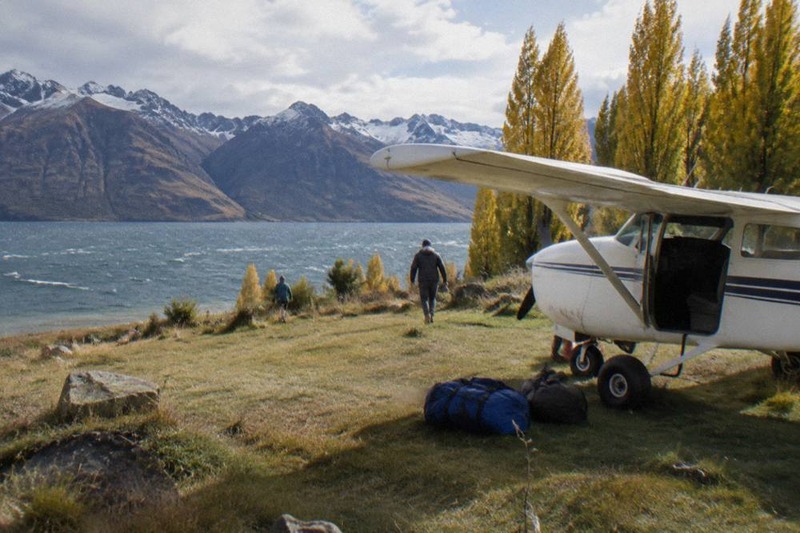
Do You Feel It In Your Stomach When You Skydive?
The stomach-drop question, answered honestly: what a tandem skydive over Queenstown or Wanaka actually feels like, what the operators state, and what to do before check-in.
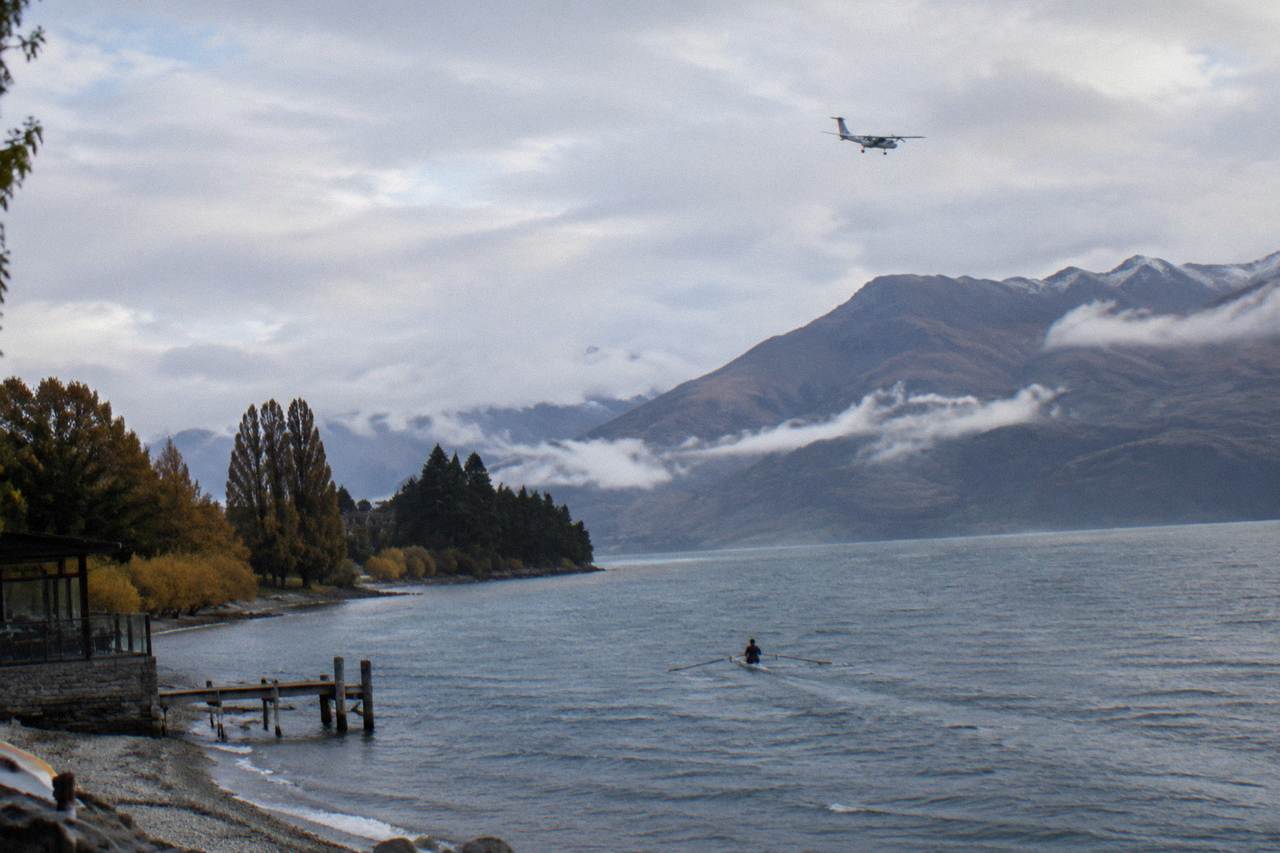
In short: most first-time tandem skydivers describe little or no true stomach drop, because a skydive does not work like a fairground ride. You reach falling speed within seconds and then the sensation steadies. The parts that unsettle people more often are the door, the exit and the nerves on the climb. NZONE states the numbers: 200 km/h, 15 to 20 minutes to altitude, freefall up to 25, 45 or 60 seconds depending on how high you jump, and 3 to 4 minutes under the parachute.
This question sits at the centre of every booking decision. A price, an altitude and a review score are all easy to compare; the falling feeling is not, because you cannot look it up the way you look up a fare. What follows separates what the operators state on their own pages from the general, widely known explanation of why freefall feels the way it does, clearly labelled as such. The three tandem options covered here are NZONE Skydive in Queenstown, the 3-Hour Wanaka Skydive, and Wanaka Skydive, Transfers Included. More on how a Queenstown tandem day runs later in this piece, because knowing the sequence of the day removes half the anxiety on its own.
Yes, many first-time jumpers do notice a stomach-drop sensation, but the honest answer, based on what they widely report rather than any operator claim, is that the intense elevator-plunge feeling is either brief or absent, and it does not last through the freefall. A roller-coaster drop produces the stomach sensation because the fall starts suddenly and stops suddenly. In a skydive you accelerate over the first few seconds after exit, reach a steady speed, and then hold it. NZONE states a freefall speed of 200 km/h and freefall of up to 25, 45 or 60 seconds by altitude; none of that is a promise of what you will feel, only what the jump involves.
“It was really awesome. We enjoyed every bit of the experience and it was well worth the money. Also, the photos and videos we got afterwards were amazing. I went with my 13-year-old son and we both had a blast. I would highly recommend it, and would definitely do it again!”
That distinction matters. The operators cannot and do not promise sensations, and neither does this page. What they do state is the physical shape of the jump: at NZONE, a 15 to 20 minute climb in the aircraft, a controlled exit attached to a tandem master, a freefall measured in tens of seconds, then 3 to 4 minutes of canopy flight. When people who have jumped describe the feeling afterwards, the words that come up are wind, pressure, noise and speed rather than the drop-in-the-gut lurch of a fairground ride.
The nerves are real, though, and pretending otherwise helps nobody. Almost everyone feels apprehension on the climb, and that apprehension frequently sits in the stomach. So there is a version of yes in the answer: you may well feel something in your stomach, but on the way up, not the way down. The sensation people fear and the sensation most jumpers actually get are two different things, and knowing that before check-in is worth more than any breathing exercise.
“NZONE is a great operation. The people at checkin were friendly and helpful, the transport to the jump zone was comfortable, and the crew on the ground were amazing.”
The exit itself is the one moment that genuinely catches people. It lasts a second or two: you move to the door, the tandem master takes over, and the aircraft is suddenly gone. Reports from first-timers describe this as the biggest single moment of the day, bigger than the freefall that follows it, precisely because it is the one instant where the change from "in a plane" to "in the air" happens fast. After that, the freefall settles into wind and speed rather than falling.
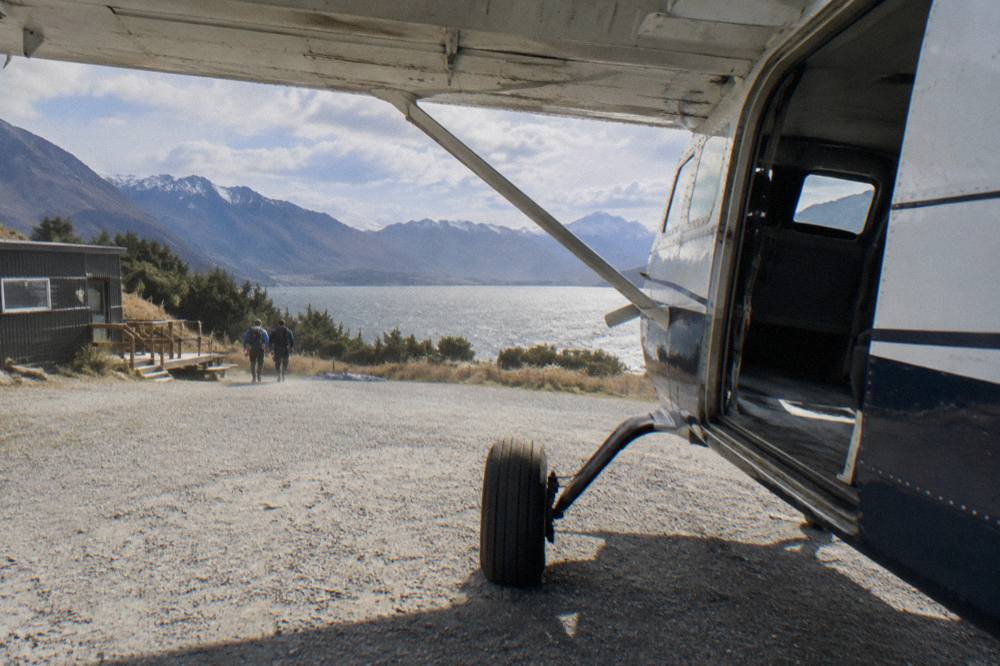
If the falling feeling is the specific thing holding you back, it helps to frame the decision around the numbers you can verify. The longest freefall on offer at either operator is up to 60 seconds from 15,000 ft. The shortest is up to 25 seconds from 9,000 ft. The canopy ride afterwards, 3 to 4 minutes per NZONE's page, is longer than every freefall option on the menu. You spend more time floating than falling, by a factor of three or more.
Why Doesn't A Skydive Feel Like A Roller Coaster Drop?
As a general point of physics, not an operator claim, the stomach-drop sensation comes from rapid changes in speed, and a skydive reaches a steady speed within seconds, so the constant change your body reacts to on a ride simply is not there for most of the freefall. On a coaster the car is slowed, held and released, and your organs lag behind each change. In freefall, once you and the air agree on a speed, nothing is being yanked away from under you, and the body has less to react to.
“SO MUCH FUN!! The views were incredible - from the plane and on the way down! The entire experience was professionally handled. We felt safe, informed and prepared. The staff was fun too!! The photo/video package was so worth it for the amazing memories. My cousin's first jump ever and now he's ready for more! Just do it!”
This is the widely accepted explanation, and it deserves its label: neither NZONE nor Skydive Wanaka states anything about physiology, and no page here should pretend they do. What the operators do state is the raw data. NZONE's prices page gives the speed as 200 km/h and the climb to altitude as 15 to 20 minutes. Its FAQ adds that a 15,000 ft flight takes about 15 minutes, and NZONE gives canopy flight as 3 to 4 minutes. Those are the verifiable bones of the experience; the feelings are yours.
There is a second reason the coaster comparison misleads. A coaster drop happens with your body held in a seat, restricted, watching the ground rotate towards you. A skydive exit happens lying against a tandem master, facing a horizon of mountains, with wind arriving from a direction you have never felt wind arrive from. The scenery matters more than people expect. Over Queenstown the drop zone sits at Drift Bay on Lake Wakatipu; over Wanaka the jump runs out of Wanaka Airport with the landing on a private farm nearby. The view is doing a lot of the sensory work.
What About The Airplane Climb?
The climb is the quiet part of the answer. NZONE states 15 to 20 minutes to altitude, which is a long time to sit with your own thoughts. Many jumpers report that this, not the freefall, is where the stomach does its worst work, a slow build of nerves rather than any physical sensation of falling. Knowing this in advance lets you treat the climb as the hard part and the jump as the release.
What About The Parachute Opening?
The canopy opening is the other moment worth naming. It is a deceleration, from freefall speed to canopy speed, felt as a firm lift into the harness. This is closer to the change-of-speed sensation people associate with drops, but it is brief and it arrives as an upward pull rather than a fall. NZONE gives 3 to 4 minutes of canopy flight after it, which for many jumpers becomes the favourite part of the whole day once the ground stops rushing.
“Nothing short of amazing! If you are unsure about skydiving or scared because it you have never done it before I highly recommend this company. They were organized, professional, and guided you through step by step the entire process and what to expect. We dove at 15,000 feet and it was spectacular! The adrenaline rush, the views, the spins, and the amazing photos/ video you get at the end was great.”
How Fast And How Long Is The Freefall At Queenstown And Wanaka?
The freefall lasts up to 25 seconds from 9,000 ft, up to 45 seconds from 12,000 ft, and up to 60 seconds from 15,000 ft, and it happens at 200 km/h. That speed is NZONE's stated figure; Skydive Wanaka lists the same altitude and freefall ladder but states no speed. "Up to" is the operative phrase; no operator promises a fixed freefall duration, and NZONE's terms say altitude, freefall duration and times can change. The table below shows each operator's stated entry price at 9,000 ft alongside the ladder.
| Altitude | Freefall (operator's "up to") | NZONE Skydive (NZD, from) | Skydive Wanaka (NZD, from) | With Queenstown transfer (NZD, from) |
|---|---|---|---|---|
| 9,000 ft | 25 s | 379 (about USD 215.27) | 379 (about USD 210.16) | 399 (about USD 221.25) |
| 12,000 ft | 45 s | 469 (about USD 266.39) | 469 (about USD 260.07) | 489 (about USD 271.16) |
| 15,000 ft | 60 s | 575 (about USD 326.60) | 575 (about USD 318.84) | 595 (about USD 329.93) |
The USD amounts are rough equivalents of the NZD prices the operators themselves quote; the NZD figures are exactly what the NZONE prices page and the Skydive Wanaka prices page state. Higher altitudes cost more at both operators, with freefall rising from up to 25 seconds to up to 45 and then up to 60 across the ladder. If the fear is the falling feeling, the 9,000 ft jump gives you the shortest exposure to it, up to 25 seconds, at the lowest price.
Choosing by altitude is really choosing by duration of exposure. A nervous first-timer who books 15,000 ft because it is "the full experience" signs up for more than twice the freefall time of the 9,000 ft option. There is no wrong answer, but there is a mismatch that catches people: wanting the longest freefall while fearing the sensation most. Decide which of those two you actually want before you look at prices, and the choice collapses to one row of the table.
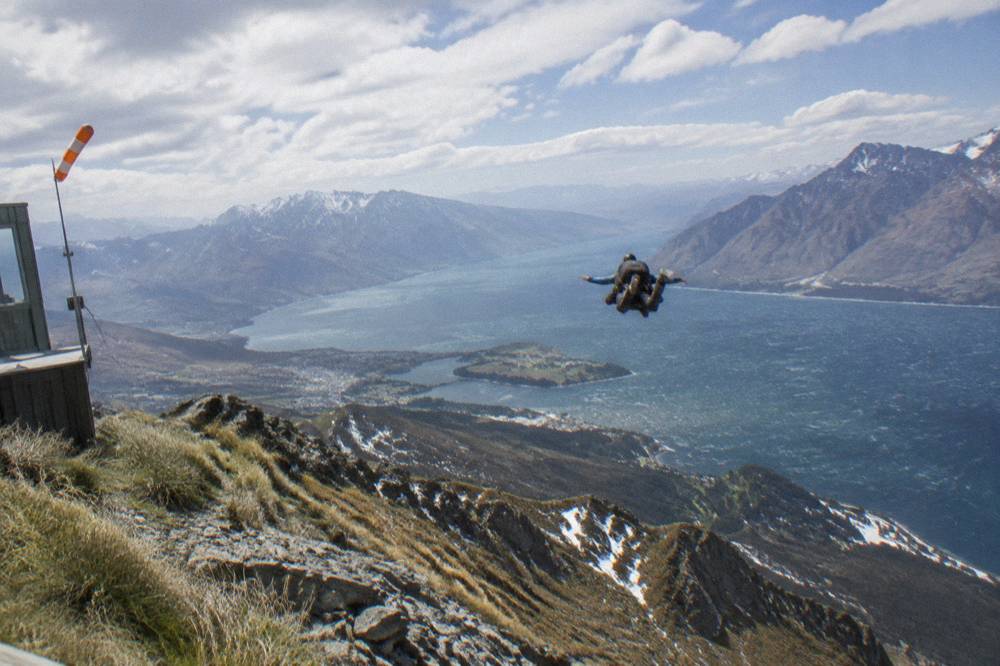
The three tour options wrap the same ladder in different logistics. NZONE Skydive starts at 35 Shotover Street in Queenstown, runs about 3.5 hours check-in to return, and includes a courtesy coach to its Drift Bay drop zone; it is the most reviewed option here at 4.7 across 1,479 reviews. The 3-Hour Wanaka Skydive runs about 3 hours from Wanaka Airport, 4.8 across 295 reviews, with pickup only at the Wanaka i-SITE shuttle point on Ardmore Street, selected at booking. Wanaka Skydive, Transfers Included adds a return transfer from 35 Shotover Street, about 1.5 hours each way, running Monday, Wednesday, Friday and Sunday only from 19 October 2026, and allows up to 6 hours for the whole experience; it is rated 4.7 from 3 reviews, too few a pool to compare with the others.
Wanaka is worth a thought even from a Queenstown base if the sensation question is driving you. The jump itself is the same ladder and the same physics, but the day has a different rhythm: a quieter airport base, a landing on a private working farm, and Mount Aspiring and Lake Wanaka in the view instead of Lake Wakatipu. The trade is travel time, which is why the transfer option exists on four days a week.
What Helps With The Nerves Before A Tandem Skydive?
Eating normally before your jump is the one piece of direct pre-jump advice Skydive Wanaka's FAQ offers, and it applies to the stomach question, and by extension the nerves question, in the most literal way: do not let anxiety talk you into skipping meals, because arriving with a normal amount of food in your stomach is exactly what the operator recommends before a tandem skydive. Skipping food to settle the stomach is a common move and the operator's guidance points the other way. Beyond that, the useful preparations are practical: arrive at your check-in time rather than a jump time, keep a spare day free in case weather moves the jump, and read the sequence of the day so nothing surprises you. If a medical condition such as diabetes adds another question mark to the day, how the Queenstown and Wanaka operators handle skydiving with diabetes explains who makes the call on the day and how to raise it before you book.
“Amazing experience. Had our first ever skydiving and it was one of a lifetime experience. Wish i could do it again.”
The "eat normally" line is easy to overlook and genuinely useful. An empty stomach does not prevent nerves, it just removes the option of eating at all once you are at the drop zone. NZONE's FAQ adds detail on the day itself: about 3.5 hours from check-in to return, aircraft holding up to 9 customers, and jumps running seven days a week through the day. None of this is a comfort guarantee; it is a map, and maps reduce nerves.
Booking structure also quietly helps. Free cancellation applies up to 24 hours before departure on all three options here, and bookings stay valid for 12 months, so a bad night's sleep the day before does not burn the money. Weather may move a jump, and the operator rebooks first, with a full refund when no other date works. Knowing the escape hatches in advance tends to lower the stakes, and lower stakes tend to settle stomachs. The booking page for each tour carries the exact terms.
“Nzone are really well organised: it was a very smooth check-in in their office in town, and at the airstrip. All the staff that helped us were really friendly, and my tandem instructor was really calm, friendly and respectful.”
A few smaller things are stated by the operators and matter to comfort. Wear secure enclosed shoes and dress for the season; a jumpsuit, gloves, hat and goggles are provided, and the goggles fit over glasses. Personal cameras and smart glasses are not allowed on the jump, an NZPIA safety rule both operators apply, so the temptation to film your own exit is removed and with it one more thing to hold. Photo and video packages, NZD 220 to 395 at either operator, are bought at check-in and filmed by the tandem master or a camera flyer, not by you.
Common Mistakes That Make The Sensation Seem Worse
The main mistake is arriving underprepared, and it takes familiar forms: jumping on an empty stomach, building an itinerary with no spare day, treating a check-in time as a jump time, and picking an altitude for bragging rights rather than for the nervous system doing the jumping. Each of these is avoidable in the five minutes it takes to read the operator's own FAQ, and each one adds avoidable dread to a day whose actual difficulty is mostly the anticipation.
| Mistake | Why it backfires | The fix |
|---|---|---|
| Skipping breakfast | Nerves plus an empty stomach plus the flight to altitude | Eat normally, per Skydive Wanaka's FAQ |
| Booking 15,000 ft out of pride | Up to 60 s of freefall when the fear is the fall | Start at 9,000 ft, up to 25 s |
| Squeezing the jump into one day | Weather can move it and then it is gone | Keep a spare day; bookings valid 12 months |
| Treating check-in as jump time | Hours of waiting you did not plan for | Plan the whole window, about 3 to 3.5 h |
| Scuba diving the day before | Operators bar it within 24 h of a jump | Leave a clear day before the skydive |
The second mistake is subtler: fighting the information. Some people deliberately avoid reading anything about the day, reasoning that ignorance keeps the fear down. The opposite happens. Unnamed things loom; named things shrink. The climb has a length, the freefall has a maximum, the opening has a direction, and the whole event is over inside half a day. The operators publish all of it, and NZONE's FAQ page is the single best page a nervous first-timer in Queenstown can read the night before.
The third mistake is expecting the video to match the feeling. Footage of a jump, shot from a wrist camera or a camera flyer's helmet, looks calmer than the day felt, because the camera has no nervous system. Jumpers frequently report that watching their own video afterwards recolours the memory: the exit that felt enormous looks like two seconds of motion, and the freefall that felt endless looks like less than a minute, which is exactly what it was, up to 60 seconds at most.
One planning point specific to Queenstown: the drop zones are not interchangeable, and where you jump shapes the whole day. NZONE's coach runs from the Skydive Centre at 35 Shotover Street to Drift Bay on Lake Wakatipu and back, included in the price, with no hotel pickup. The Wanaka options jump from Wanaka Airport. Spectators travel differently at each, and Skydive Wanaka notes there is no safe spectator viewing at its farm landing zone, though friends are welcome at the airport base. If someone is coming to watch, check the Skydive Wanaka getting-here page or NZONE's pickup details before the day.
“It was such a breathtaking experience, amazing and terrifying at the same time. The instructors were so nice and comforting and they’ve all done thousands of jumps.”
The Short Version For Nervous First-Timers
If the stomach drop is the only thing between you and booking, stack the small wins: book the shortest freefall option so the drop lasts as little as possible, eat a normal breakfast, read the operator's FAQ so nothing catches you off guard, and give the day room to move. That is the whole recipe for a nervous first-timer. The 9,000 ft option costs the least, from about USD 215.27 with NZONE or about USD 210.16 in Wanaka, exposes you to up to 25 seconds of the sensation you fear, and still delivers the full arc: the climb, the exit, the freefall, the 3 to 4 minutes of canopy, and the walk back into the building with the thing done.
The fear deserves respect, not dismissal. What the fear does not deserve is veto power based on a guess about how the fall will feel, because the guess is usually worse than the jump. The verified numbers are on the operators' pages, the review counts are printed beside every option here, and the day itself is shorter, and steadier, than the months of imagining that tend to precede it.
“Well organized. First time skydive from 15000 ft. The colleague are very professional and friendly. Also there are many interactions from the coach. Great experience. If u never tried skydive, this is a must do experience.”
NZONE Skydive remains the natural first call for a Queenstown-based trip: the courtesy coach, the 35 Shotover Street check-in and the 4.7 across 1,479 reviews all point that way, and choosing your Queenstown skydive altitude is the one decision left after that. Whatever you pick, the sequence of the day is the same, and so is the honest answer to the question this page started with: a moment of everything at the door, a steady rush after it, and a long, quiet float home over the lake.
Common Questions
Do You Feel It In Your Stomach When You Skydive?
Most first-time jumpers report little or no roller-coaster stomach drop, because freefall reaches a steady speed within seconds rather than changing speed like a ride. This is general report, not an operator claim; no operator promises a sensation.
Does The Parachute Opening Feel Like A Drop?
It is the opposite direction. The opening is a deceleration from freefall speed, felt as a firm upward lift into the harness rather than a fall. It lasts a moment, and NZONE's page then gives 3 to 4 minutes of canopy flight, which many jumpers describe as the calmest part of the day.
Which Altitude Gives The Least Falling Sensation?
9,000 ft, with freefall up to 25 seconds, the shortest exposure on either operator's ladder. Each step up adds roughly 20 seconds: up to 45 seconds at 12,000 ft and up to 60 seconds at 15,000 ft, at 200 km/h on NZONE's page.
Should You Eat Before A Skydive?
Yes. Skydive Wanaka's FAQ says to eat normally before your jump. Skipping food does not prevent nerves and leaves nothing in the tank for a day that runs about 3 hours at Wanaka or about 3.5 hours with NZONE, check-in to return.
Can You Back Out If The Nerves Win The Night Before?
Free cancellation applies up to 24 hours before departure on all three options covered here, and a booking stays valid for 12 months. Within 24 hours the fee is 100 percent. Weather moves are different: the operator rebooks first, and a full refund applies when no other date works.
Is It Scarier Than Bungy?
The two fears are different in shape: a bungy is a short, sudden drop, while a tandem skydive is a steady rush after a long build. Neither operator claims one is scarier, and no page here will either. The Queenstown Tandem Skydive guides cover the comparison in detail if you are deciding between them.